
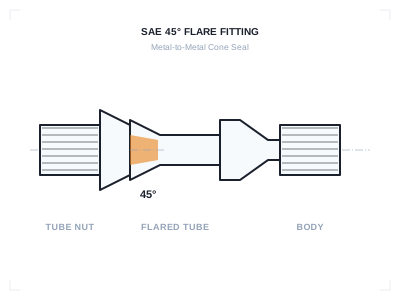
The SAE 45° flare fitting is the dominant connection style in HVACR refrigerant line work and is also widely used in natural gas distribution, propane (LP) service, and certain plumbing applications. The fitting relies on a precision-machined 45° conical sealing surface — the tubing end is mechanically flared to the same 45° angle using a flaring tool, and a threaded flare nut draws the flared tubing against the fitting's sealing cone to create a metal-to-metal seal without gaskets or thread sealant.
The 45° flare angle is standardized under SAE J512 (Society of Automotive Engineers) and ARI 750 (Air-Conditioning, Heating, and Refrigeration Institute) for use in copper, aluminum, and brass tubing service. This standardization means flare fittings from different manufacturers are mechanically interchangeable as long as they conform to the standard — important for service work where the original equipment manufacturer's brand may not be available.
The complete flare fitting family includes unions (which join two flared tubing ends), reducing unions (for transitioning between tubing sizes), elbows in 45° and 90° configurations (for direction changes), tees for branch lines, flare-to-NPT and flare-to-BSP adapters (for connecting flared tubing to threaded pipe), and the flare nuts themselves, which are sold separately to match the tubing size being terminated.
Materials are application-dependent. Brass is the most common base material for both the fitting bodies and the flare nuts, with C36000 free-machining brass typical for industrial HVACR work. For potable water plumbing, lead-free brass alloys conforming to NSF 61 and NSF 372 are required. For LP and natural gas service, brass is the default — UL-recognized fittings carry separate certification marks for fuel gas duty.
Finishes include natural brass for general industrial use, chrome plate for retail-visible plumbing, and tin or nickel for specific corrosion-resistance requirements.