
Forged brass pipe fittings are manufactured by heating brass rod or billet to a forging temperature and then pressing it into a near-net-shape die under high tonnage — followed by CNC machining of the thread profiles, sealing surfaces, and any internal passages. This process is distinct from cast brass fittings (where molten brass is poured into a mold) and produces a denser, finer-grained microstructure that performs substantially better under cyclic pressure, temperature variation, and mechanical stress than equivalent castings.
In industrial pipe service, forged brass fittings are the standard for any application above light commercial water pressure. They are used in compressed air systems, hydraulic accessory connections, instrument tubing manifold sub-assemblies, fuel distribution networks, and any branch or transition where higher pressure ratings and longer fatigue life justify the additional cost over cast brass.
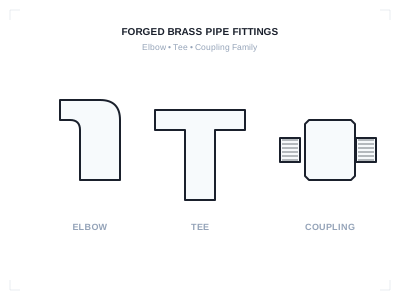
The forged brass pipe fitting family covers the full range of pipe-thread geometry. Elbows in 90° and 45° configurations change pipe direction. Street elbows (with one male thread and one female) make tight transitions in confined spaces. Equal tees and reducing tees create branch lines, with reducing tees stepping down to a smaller branch size while maintaining run continuity. Crosses provide four-way connections at distribution headers. Couplings and reducing couplings join straight runs of equal or different sizes. Hex nipples, close nipples, and pipe bushings handle short transitions between male threads. Caps and plugs terminate runs.
Forged brass fittings are typically supplied in C37700 forging brass (the standard alloy for hot-forged brass components) or C36000 free-machining brass for fittings that require significant secondary machining after forging. Threads conform to NPT (ANSI B1.20.1) or BSPT (BS EN 10226) depending on the market, and class 150 or class 3000# pressure ratings are common — the 3000# class being standard for oil and gas service.