
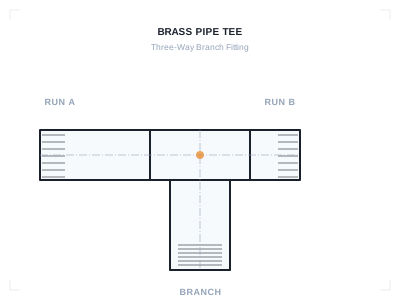
Brass pipe tees provide a three-way connection wherever a branch line is needed off a main piping run — for fixture supplies, instrument taps, drain points, equipment feeds, or any other distribution geometry that requires splitting one line into two. The fitting has three ports arranged in a T configuration: two in line with each other (the run, sometimes called the straight-through) and one perpendicular to the run (the branch or outlet).
Two primary configurations are common. The equal tee has all three ports the same size — used when the branch line carries the same flow as the run and is built from the same pipe size. The reducing tee has a smaller branch port than the run, used when a smaller-diameter fixture or instrument is being supplied from a larger main. Some reducing tees also step down one of the run ports, allowing the tee to function as both a branch and a size transition in a single fitting — useful for compact distribution layouts.
The internal geometry of a brass tee is typically a smooth T with the branch entering at 90° to the run. This produces some flow disturbance at the junction, but in most plumbing, gas, and pneumatic applications the disturbance is acceptable. For applications where minimal flow disruption matters (such as some instrument lines or precision metering setups), Y-tees with the branch at a shallower angle are also available.
Material selection follows the same patterns as other brass pipe fittings. C36000 free-machining brass and C37700 forging brass are standard for industrial work. Lead-free brass conforming to NSF 61 and NSF 372 is required for potable water service. 3000# class forged brass tees are standard for high-pressure oil and gas distribution. Threads are typically NPT in North America, BSPT internationally, with both being tapered for compression-style sealing.