
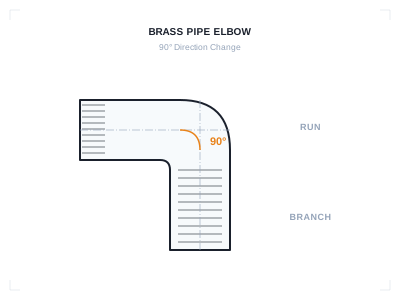
Brass pipe elbows are among the most fundamental fittings in any threaded piping system, used wherever a change in direction is needed — whether to route around an obstacle, to drop down into a fixture, or to connect parallel runs. The two standard angles are 90° (the most common, for right-angle direction changes) and 45° (for gentler transitions that reduce flow resistance and pressure drop compared to a sharp 90°).
Three configurations cover most use cases. The standard elbow has female threads on both ends, accepting two male-threaded pipe segments. The street elbow has one male thread and one female thread — designed for direct connection into another fitting without a nipple, which saves space and reduces leak paths in tight installations. The reducing elbow steps down to a smaller thread size at one end, useful for transitioning between pipe sizes at a direction change.
Material selection depends on service. For general industrial water, gas, and air service, C36000 free-machining brass or C37700 forging brass is standard. For potable water systems where the elbow contacts drinking water, lead-free brass alloys compliant with NSF 61 and NSF 372 are required by federal law in the United States. For oil and gas applications, 3000# class forged brass elbows in C37700 are typical, often with full material test reports.
Thread profiles are application-dependent. NPT (American National Standard Pipe Thread) per ANSI B1.20.1 is dominant in North America. BSPT (British Standard Pipe Tapered) per BS EN 10226 is standard internationally. Both are tapered threads that achieve their seal by the deformation of the threads themselves as they are tightened — typically with a thread sealant compound or PTFE tape to fill the spiral leak path.
Finishes range from natural brass (industrial default) to chrome, nickel, and tin plating for specific cosmetic or corrosion-resistance needs.