
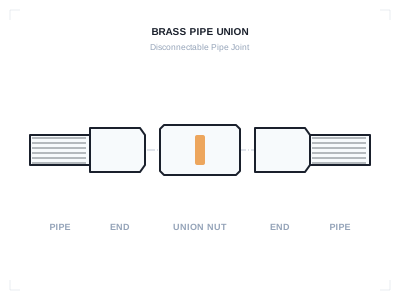
Couplings and unions are the basic linking fittings of any threaded pipe system, used to join two straight pipe ends in line with each other. The two fittings serve different functional purposes — couplings create a permanent or semi-permanent joint that requires unscrewing one of the connected pipes to disassemble, while unions are specifically designed to be disconnected and reconnected without disturbing the rest of the line, making them essential at any point in a piping system where maintenance access matters.
A standard coupling has female threads at both ends, accepting two male-threaded pipes that meet inside the coupling body. Reducing couplings step from one thread size to another, allowing a transition between pipe diameters in a single fitting. Coupling installation creates a tapered-thread seal at each end, typically with a thread sealant compound or PTFE tape applied to the male threads before assembly.
A pipe union is a three-part fitting designed for disassembly. The two threaded end pieces are installed on the pipes to be connected, then drawn together by a central threaded nut (sometimes with an integral O-ring or metal-to-metal seal at the mating surface). To break the joint, the union nut is unscrewed and the two end pieces can be pulled apart without rotating either of the connected pipes. This makes unions invaluable at equipment connections, valve isolation points, instrument loops, and anywhere else routine disconnection is expected.
Material and thread standards follow the same pattern as other brass pipe fittings. Industrial work typically uses C36000 or C37700 brass with NPT threads in North America and BSPT internationally. Potable water service requires lead-free brass per NSF 61 and NSF 372. High-pressure oil and gas service typically calls for 3000# class forged brass unions with metal-to-metal seals — no soft gaskets that could fail under pressure cycling.