
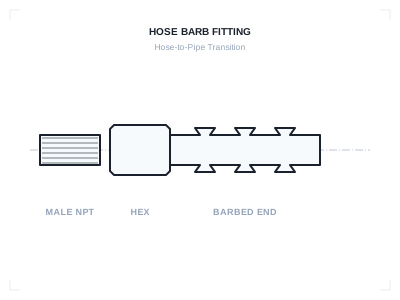
Hose barb fittings provide the connection between flexible hose and threaded pipe in a wide range of plumbing, equipment, and outdoor water supply applications. The barb itself is a series of tapered ridges machined into the outside of the fitting — when the hose is pushed onto the barb, the ridges grip the inside of the hose, and a hose clamp tightened over the hose-and-barb assembly creates the seal. The other end of the fitting is typically threaded for connection to a pipe, faucet, or piece of equipment.
The simplest hose barb is a male-threaded fitting (NPT, BSP, or garden hose thread) with a single straight barb. From this base, the hose barb family extends into elbow configurations (for direction changes at hose connection points), tees (for branching one hose into two), reducing barbs (for connecting different hose sizes), and double-barb couplings (for joining two hose sections directly).
Swivel hose connectors include a rotating coupling between the threaded end and the barb, allowing the hose to twist without binding — important for laundry equipment supply hoses, garden tools that are rotated during use, and any application where the hose moves repeatedly during normal operation. Washing machine swivel connectors are a specialized type with two threaded connections (one for the hose, one for the supply valve) and a swivel in the middle.
Garden hose fittings are a related family using the GHT (Garden Hose Thread) standard rather than NPT — GHT is a coarser, straight thread sealed by a rubber gasket rather than the tapered-thread seal used by NPT. Garden hose fittings include simple barb-to-GHT adapters, swivel connectors, Y-splitters, and shutoff connectors.
Material selection for hose barbs follows the standard brass alloy patterns. Industrial work typically uses C36000 brass. Potable water service requires lead-free brass per NSF 61 and NSF 372. Outdoor work occasionally uses nickel or chrome plating for added corrosion resistance.