
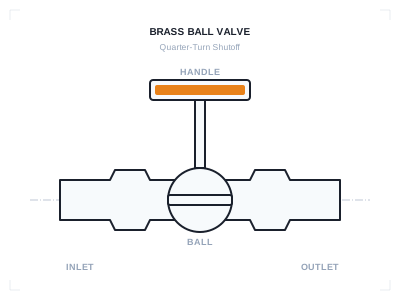
The brass ball valve is the most common manual shutoff valve in plumbing, gas distribution, and light industrial service. The valve works by a simple, durable mechanism: a polished brass ball with a hole drilled through it rotates between two PTFE (Teflon) or PEEK seats inside the valve body. When the ball's hole is aligned with the flow direction, the valve is fully open; when the ball is rotated 90° (a quarter turn of the handle), the solid side of the ball faces the flow and the valve is fully closed.
The quarter-turn design has several advantages over multi-turn gate or globe valves. Operation is faster — a single handle motion fully opens or fully closes the valve, with no in-between throttling positions to wear out the seat surfaces. The handle position provides a clear visual indication of open or closed status, useful in emergencies. Internal flow resistance is low because the bore of the ball passes flow in a straight line with no internal restrictions or direction changes.
Ball valve sizes range from small bibcock and faucet shutoffs up through main-line valves several inches in nominal pipe size. End connections include threaded (NPT, BSPT, or BSPP), solder/sweat for copper systems, push-to-connect for PEX or copper, and compression for water service line work. Some ball valves include drainable port designs for use in service line applications where a downstream isolation point with a drain capability is required.
Materials for the wetted parts are typically brass for the body and chrome-plated brass or stainless steel for the ball itself. Seats are PTFE for standard water and gas service, with reinforced PTFE or PEEK options for higher-temperature applications. The complete valve assembly is supplied with the handle attached, often in a contrasting color (red, blue, or yellow) for visual identification. Lead-free brass options conforming to NSF 61 and NSF 372 are required for potable water service.