
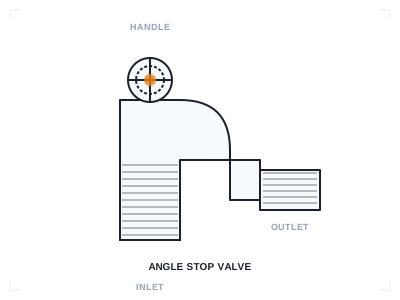
Angle stop valves are the small shutoff valves found immediately below sinks, toilets, dishwashers, ice makers, and other fixtures in residential and light commercial plumbing. The valve combines two functions in a single compact fitting: a 90° direction change (turning the supply line from the wall outward to the fixture) and a manual shutoff (allowing the fixture to be isolated for repair or replacement without shutting off the water to the entire building).
Two internal mechanisms are common. The quarter-turn angle stop uses the same ball-and-seat design as a standard ball valve, with a quarter-turn handle for fast open/close operation. The multi-turn angle stop (sometimes called a compression stop) uses a stem-and-washer mechanism that requires several turns of the handle to fully open or close — slower, but with more controllable throttling and a longer historical service track record. Modern construction typically favors quarter-turn for new installation work; multi-turn remains common in repair work where the existing valves are being replaced in place.
Inlet connections include 1/2" or 5/8" compression (the dominant standard for copper service line work), 1/2" or 3/4" male NPT (for threaded supply lines), PEX crimp or push-fit (for new PEX construction), and 1/2" sweat (for direct copper soldering). The outlet is typically 3/8" compression or 1/4" compression — sized for the standard faucet, toilet, or appliance supply line that connects to the fixture.
Because angle stops are visible in finished installations (under sinks and behind toilets), chrome plate is the dominant finish for residential work. Industrial and commercial applications more often use natural brass or nickel finish. All angle stops serving potable water must be manufactured from lead-free brass conforming to NSF 61 and NSF 372.