
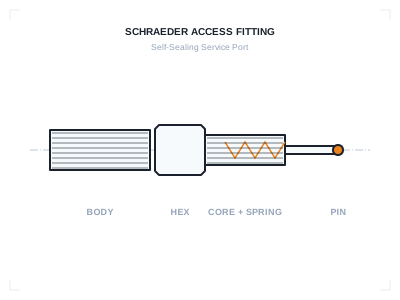
Schraeder access fittings are the small valved ports found throughout HVACR systems wherever gauge connection or refrigerant charging access is needed. The fitting uses the same poppet-valve mechanism as an automotive tire valve — a spring-loaded core that is normally closed by gas pressure, and that opens when a service hose connector depresses the central pin. This makes the Schraeder fitting self-sealing: when no service hose is connected, the core stays closed; when a hose is connected, the core opens and gas can flow in either direction.
The complete Schraeder fitting consists of two parts: the fitting body (brass, with male threads for installation into the system and female threads at the service end for the gauge hose connector) and the removable core (brass and stainless steel, with the spring and seal). The core is a serviceable item — a special core removal tool allows it to be unscrewed without disconnecting the fitting from the system, so a worn or leaking core can be replaced without major disassembly.
In HVACR service work, Schraeder fittings are found at multiple points in any system: at the compressor service valves for gauge connection, on the suction and discharge sides of the compressor for pressure measurement, at the high and low side service ports of any sealed system, on the inlet of any pressure switch or transducer for testing access, and at the outlet of refrigerant cylinders for hose connection during charging.
The fittings are sized for standard service hoses — typically 1/4" SAE male flare or 5/16" SAE male flare for North American HVACR work, with metric M14 or M16 sizes for European and Asian systems. Pressure ratings cover the full range of common refrigerants. EPDM and HNBR are the typical core seal materials, with selection based on the specific refrigerant in service.