
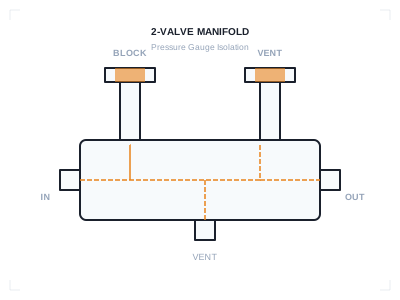
The 2-valve manifold is the simplest of the standard instrument manifold configurations, integrating two valves into a single forged or machined block for use at pressure gauges, pressure transmitters, and similar single-point measurement instruments. The two valves serve distinct functions: a block valve isolates the instrument from the process line, and a vent or drain valve allows the pressure on the instrument side to be relieved or sampled when the block valve is closed.
In typical service, both valves are normally configured so that the block valve is open (connecting the instrument to the process pressure) and the vent valve is closed (containing the process pressure on the instrument side). When the instrument needs to be removed, calibrated, or serviced, the procedure is to first close the block valve (isolating the instrument from the process), then open the vent valve (relieving the trapped pressure between the block valve and the instrument). The instrument can then be safely removed without exposing the technician to process pressure.
The 2-valve manifold is found in installations where a vent or drain capability is needed but where there is no requirement for an equalization function (which is what distinguishes the 2-valve from the 3-valve manifold used with differential pressure transmitters). Common applications include pressure gauge isolation in process plants, pressure transmitter installations where the transmitter is single-point rather than differential, and any other isolation point where the operator needs to isolate, vent, and remove the instrument with a defined procedure.
The valves themselves can be needle valves (for fine throttling and precise control of low flows during venting) or ball valves (for quick on/off operation when fine control isn't needed). Needle valves are more common in process plant work because they provide better throttling control during venting and allow gradual pressure relief without the sudden pressure drop that a ball valve can cause.
Material construction is typically C37700 forging brass or 316 stainless steel, with end connections in NPT, BSP, or instrument tube fitting style depending on the application.