
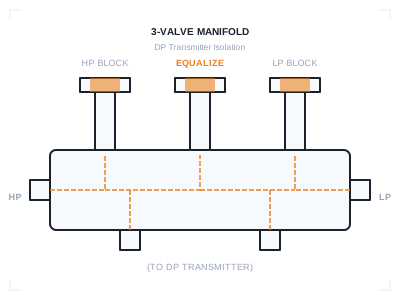
The 3-valve manifold is the standard isolation manifold for differential pressure (DP) transmitters used in flow measurement, level measurement, and density measurement applications. Unlike a 2-valve manifold (which serves single-point pressure instruments), the 3-valve manifold has the specific function of safely isolating a DP transmitter from a process line that has potentially significant pressure differential between the high-pressure and low-pressure sides.
The three valves serve coordinated functions. Two block valves — one on the high-pressure side and one on the low-pressure side — isolate the transmitter from the process line connections. The third valve, an equalizing valve, connects the high and low pressure sides of the transmitter directly to each other. During normal operation, both block valves are open and the equalizing valve is closed — the transmitter sees the process differential pressure across its sensing element. To safely remove the transmitter, the equalizing valve is opened first (which brings both sides of the transmitter to the same pressure, protecting the sensing element from a one-sided overpressure event), then both block valves are closed (isolating the transmitter from the process), then the transmitter can be safely removed.
This safe-isolation procedure is critical because DP transmitter sensing elements (typically capacitive or piezoresistive diaphragms) can be permanently damaged if one side is isolated while the other side remains pressurized — even a brief overpressure event on one side can deform the diaphragm and require expensive transmitter replacement. The 3-valve manifold's equalizing valve eliminates this risk by ensuring both sides equalize before isolation.
The valves are typically needle valves for fine throttling control. The valve handles are usually color-coded — block valves in one color (often red), the equalizing valve in another (often green or yellow) — to help operators follow the correct sequence visually during the isolation procedure.
Material selection follows the same patterns as other oil and gas instrumentation fittings: C37700 forging brass for general service, 316 stainless steel for corrosive or high-pressure applications, with NPT, BSP, or instrument tube fitting end connections.