
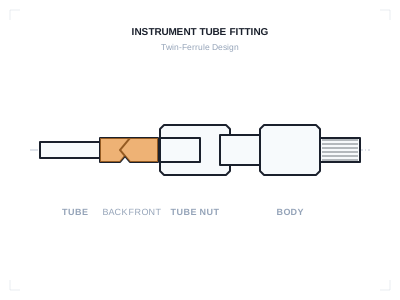
The twin-ferrule instrument tube fitting is the dominant connection style for small-bore process tubing in instrumentation, sampling, analytical, and high-pressure laboratory applications. The fitting uses two distinct ferrules — a front ferrule and a back ferrule — that work together to create both the seal against the tubing surface and the mechanical grip that anchors the tubing in the fitting body. The two-ferrule design is the key technical difference from single-ferrule compression fittings, and produces substantially higher pressure ratings and better resistance to vibration-induced leakage.
During installation, the tube is inserted into the fitting body up to the internal shoulder, and the nut is finger-tightened. Then the nut is tightened a specified amount with a wrench (typically 1-1/4 turns from finger-tight for the first installation), which drives the front ferrule against the body's sealing cone — deforming the front ferrule against the tubing OD to create the primary seal. The back ferrule then drives against the front ferrule, providing the mechanical bite that grips the tubing and prevents it from pulling out under pressure.
The two-ferrule design has a critical advantage for service and remake — the ferrules become permanently swaged to the tubing after the first installation, but the fitting can be disconnected and reconnected multiple times without disturbing the seal performance, as long as the same tubing and ferrules are used. This makes the fitting style ideal for instrument loops where periodic disconnection for calibration or maintenance is expected.
The fitting family covers the standard tube geometry range. Unions join two tube ends. Reducing unions transition between tube sizes. Tube elbows and tees handle direction changes and branches. Tube-to-NPT and tube-to-BSP adapters connect tubing to threaded process equipment. Bulkhead fittings allow tubing to pass through panels and enclosures. Tube nuts and ferrules are also sold separately for service work.
Materials include C36000 brass for general low-pressure service, 316 stainless steel for high-pressure and corrosion-resistant service, and specialty alloys for chemical compatibility with specific process fluids.