
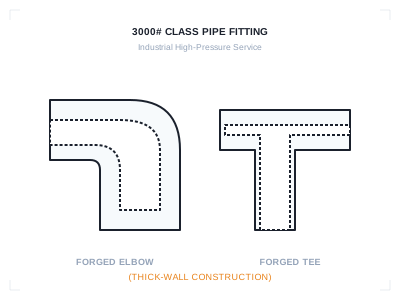
The 3000# (three-thousand pound) class of forged pipe fittings is a standardized pressure-rating designation under ASME B16.11 covering forged steel and forged brass fittings used in industrial process piping, oil and gas distribution, hydraulic systems, and other high-pressure service applications. The 3000# class is the most common forged-fitting rating in oilfield and refinery work — substantially higher pressure capability than the 150# and 300# classes used in light commercial and water service piping.
Forged 3000# fittings are distinguished from cast fittings by their manufacturing process. The starting material is a solid brass billet that is heated to forging temperature and pressed into a near-net-shape die under high tonnage. The forging operation produces a dense, fine-grained microstructure that performs substantially better under cyclic pressure loading, temperature variation, and mechanical stress than equivalent castings. After forging, the fitting is CNC-machined to its final dimensions, with the threads, sealing surfaces, and internal passages cut to the precise tolerances required by the ASME standard.
The complete 3000# forged fitting family covers all standard pipe-thread geometries: 90° and 45° elbows, street elbows for tight transitions, equal tees and reducing tees for branch lines, crosses for four-way distribution, couplings and reducing couplings for straight runs, hex nipples and pipe bushings for short transitions, caps for terminating runs, and hex plugs for sealing unused ports. Unions are also produced — typically metal-to-metal seal style rather than gasketed, because soft gaskets are not appropriate for the pressure cycling expected at 3000# class service.
Materials are typically C37700 forging brass for the standard product, with full material test reports (MTRs) supplied per ASME requirements. Threads are NPT (ANSI B1.20.1) for North American work or BSPT for international supply. The class rating itself refers to the standardized pressure-temperature ratings published in ASME B16.11 — the rating decreases as service temperature rises, following the standard derating curves for the alloy.