
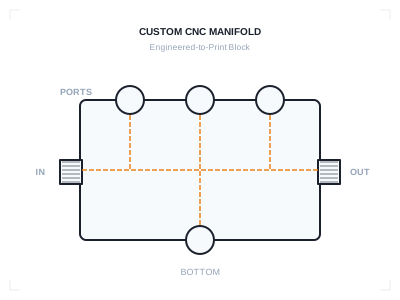
Custom CNC manifold blocks are engineered-to-print brass components that combine multiple fluid distribution paths into a single machined part. Rather than building a manifold from individual elbows, tees, couplings, and pipe sections, a custom manifold integrates all of the necessary flow geometry into one solid block — reducing the number of joints (and therefore leak paths), simplifying assembly, and improving overall reliability of the fluid system.
The production process starts from customer-supplied CAD drawings (typically STEP or IGES format, with 2D dimensional drawings for tolerance and surface-finish callouts). The starting material is a solid brass billet, sized to provide adequate material around all of the planned internal passages and external mounting features. CNC machining then proceeds through multiple operations: external profile machining, drilling of all internal passages (often using gun-drilling for long, straight bores), cross-drilling at intersection points, threading of all external ports, and finish machining of sealing surfaces.
In automotive applications, custom CNC manifolds are commonly found in engine fluid distribution (engine oil and coolant headers, transmission fluid distribution blocks), brake proportioning systems (combining the brake pressure modulator and brake distribution functions into one block), and fuel system distribution (especially for direct-injection engines where multiple injector feeds emerge from a single rail).
In industrial and process applications, custom manifolds are used for instrumentation interface blocks (combining multiple measurement port connections into one mount), valve sub-assemblies (where multiple valve bodies share a common base block), and hydraulic distribution headers.
Material selection depends on the service. C36000 free-machining brass is the standard for ease of machining and dimensional stability. C37700 forging brass is used when the manifold geometry includes features that benefit from a forged-pre-machined blank. Aluminum 6061-T6 is used where weight matters and the service pressures are moderate. PPAP documentation, control plans, and FMEA are standard for automotive OEM supply.