
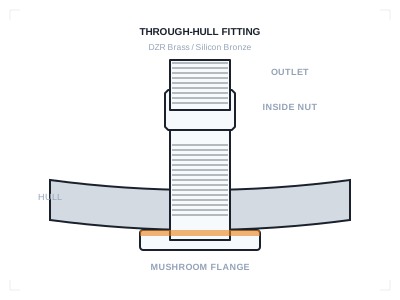
Through-hull fittings are the watertight transitions where engine raw-water intakes, raw-water discharges, head and bilge drains, instrument transducers, and other fluid connections pass through a vessel's hull. Below-waterline through-hulls are exposed to constant immersion in seawater and to the corrosion conditions that have historically destroyed standard brass within just a few years of installation. For this reason, marine-grade through-hulls are manufactured from one of two specific alloy families: dezincification-resistant (DZR) brass conforming to CW602N specification, or C65500 silicon bronze.
DZR brass (with CW602N being the European marine industry standard) is brass that has been formulated and heat-treated specifically to resist dezincification — the selective loss of zinc that destroys ordinary brass exposed to seawater over time. Silicon bronze (C65500, approximately 96% copper and 4% silicon) is the historic standard with the longest marine field service track record — it predates DZR brass by decades and is still widely specified for its proven durability in below-waterline service.
Both alloys are compliant with ABYC Standard P-1 — the American Boat and Yacht Council's standard for below-waterline metal components. NMMA (National Marine Manufacturers Association) certification is also commonly required for OEM boat builder supply.
The through-hull fitting family includes two main body styles. The standard through-hull has a flanged head on the outboard end and a threaded shank on the inboard end, with a hose barb or threaded outlet for the inboard connection. The mushroom-head through-hull has a low-profile outboard flange used for transducer mounts and instrument applications where minimal protrusion from the hull is desired.
A complete through-hull installation requires a backing plate (typically ABS plastic or G10 fiberglass) on the inboard side to distribute load across the hull material, and a bonding tab for electrical connection to the vessel's negative bus per ABYC E-2 corrosion-protection requirements. All marine through-hulls receive 100% pressure testing during production, with documentation supplied for OEM boat builder requirements.