
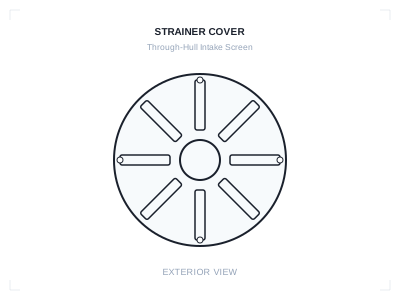
Strainer covers are the slotted, perforated, or grated covers that fit over the external face of a below-waterline through-hull intake fitting. Their purpose is mechanical filtration — preventing debris, seaweed, jellyfish, plastic bags, and other foreign objects from being drawn into the engine raw-water cooling system, air conditioning seawater pump, or any other system that draws cooling or service water from the sea.
Without a strainer cover, virtually any debris in the water can be sucked into the intake and either pass through to the engine cooling system (where it can clog the heat exchanger or break impeller blades) or accumulate at the intake hose entrance (where it can progressively reduce flow until the engine overheats). A strainer cover at the through-hull provides the first line of mechanical defense; a secondary inline strainer with a removable basket is typically installed in the engine room as a second-stage defense.
Strainer cover designs vary by intake type and vessel. Cast strainer covers (typically silicon bronze or DZR brass) are molded with the slot pattern integral to the casting. The slot orientation is typically parallel to the boat's centerline, so the slots align with the water flow direction at cruising speed and minimize induced drag. The slot widths are sized to exclude debris larger than the smallest passage in the downstream cooling system — typically 1/4" or 5/16" maximum slot width for marine engine raw-water intakes.
Grated or screened strainer covers use a finer mesh and are appropriate for installations where smaller debris is a concern — such as low-flow installations like AC seawater intakes where pump capacity is limited and even small debris accumulation can cause performance problems.
Some strainer covers are integrated into the through-hull body as a single casting; others are separate components that bolt onto the external face of the through-hull. Bolted strainer covers are easier to clean and replace but require additional fasteners that can corrode over time. Integrated designs are more durable but require complete through-hull replacement if the strainer pattern becomes damaged.
Materials match the parent through-hull — DZR brass or silicon bronze for below-waterline installations.