
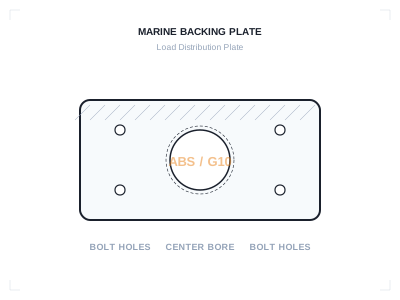
Marine backing plates are the engineered plastic or fiberglass components used to distribute the mechanical load of a through-hull fitting across a wide area of the hull material on the inboard side. Without a properly sized backing plate, the mounting nut of the through-hull fitting concentrates its tightening force on a small ring of hull material directly under the fitting flange — over time, this can cause stress cracking in the hull, deformation of the fitting bore, and eventual loss of watertight integrity at the penetration.
Two materials dominate the backing plate market. ABS (Acrylonitrile Butadiene Styrene) plastic is the most common — relatively inexpensive, easy to machine, dimensionally stable, and compatible with the marine environment. G10 fiberglass is a higher-grade option used on production OEM boats and high-quality custom builds — substantially stiffer than ABS, with better long-term creep resistance and higher load distribution capacity. G10 is the same material used in many marine bulkheads and structural inserts, and is preferred for transducer mounts where dimensional stability matters for the sensor's calibrated readings.
Backing plate sizing depends on the through-hull's flange diameter and the hull's construction. A backing plate is typically 2 to 4 times the through-hull flange diameter, providing a wide load distribution footprint. The plate is bored through the center to match the through-hull's shaft, and is often counterbored on the outboard face to receive the through-hull flange flush with the plate surface.
Installation involves bedding compound between the hull, the backing plate, and the through-hull's mating surfaces. Marine-grade polyurethane sealants (such as 3M 5200 or equivalent) are typical for permanent installation; polysulfide sealants are used where the through-hull may need to be removed for service. Bolt-through installation with multiple bolts is more secure than nut-only installation for heavy-loaded through-hulls.
Backing plates ship in standard sizes matched to common through-hull diameters, with custom sizes available for non-standard installations or specialized applications.