
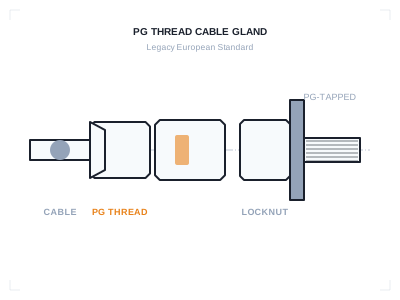
PG thread cable glands use the older Panzer-Gewinde (German for "armor thread") thread standard that predates the modern metric ISO standard. PG threads are still widely encountered in European industrial equipment, machine tool retrofit work, and any installation that interfaces with older European-built panels or enclosures. The thread profile is distinct from metric ISO and is not directly interchangeable — a PG gland cannot be installed in a metric-threaded enclosure hole and vice versa without an adapter.
Standard PG sizes include PG7, PG9, PG11, PG13.5, PG16, PG21, PG29, PG36, PG42, PG48. The number does not represent a direct dimensional measurement — PG7 corresponds approximately to a 12.5mm outside diameter thread, PG11 to about 18.6mm, and so on. The full sizing chart is provided in DIN 40430, the German national standard that originally defined the PG thread family.
Functionally, PG glands work identically to their metric counterparts. The gland body threads into the enclosure entry hole, the sealing insert and clamping mechanism grip and seal the cable jacket, and (for armored variants) an internal ferrule grounds the cable armor to the gland body. IP ratings, material options, and ATEX/IECEx certifications are available across the PG family in the same configurations as metric glands.
In modern new construction, metric glands have largely displaced PG for new equipment design. However, PG glands remain important for several use cases. Maintenance and retrofit work on existing equipment built with PG-threaded enclosures requires replacement glands in the same thread standard. Specialty machinery — including some textile equipment, packaging machinery, and machine tools — continues to be built with PG entries because of legacy compatibility with installed customer base. Aftermarket replacement parts for older European-built equipment are also typically PG.
Materials and construction options for PG cable glands match the metric family: brass, nickel-plated brass, and stainless steel, with EPDM or NBR sealing inserts selected for the application's temperature and chemical exposure profile.