
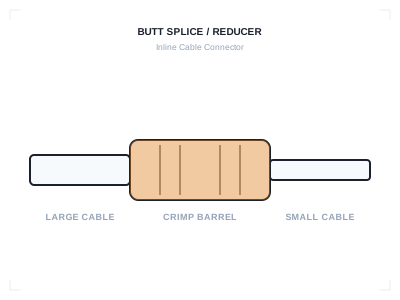
Butt splices and reducer splices are the crimp-on connectors used to permanently join two cable ends in line with each other — essentially, an inline coupling for stranded electrical conductors. The fitting is a tubular metal sleeve (typically tinned copper or brass) with a crimp zone at each end. One cable is stripped and inserted into one end, the other cable is stripped and inserted into the other end, and both ends are crimped to create a single continuous conductor.
The butt splice itself is the basic version of the fitting — both ends accept the same cable size. Common sizes range from 22-18 AWG for small instrument and signal wiring up through 4/0 AWG and larger for industrial power distribution. Color-coded insulation around the body of the splice (red, blue, yellow, etc.) indicates the cable size range the splice is designed for, following the standard industry color-code convention also used for ring and spade terminals.
The reducer splice is a variant that joins two cables of different sizes. One end is sized for a larger cable, the other for a smaller cable. This is useful in distribution work where a feeder must transition to a smaller-gauge branch line, or where mixed cable types (such as connecting a large solid feeder to a smaller stranded extension) need to be permanently joined. Common reducer combinations include 6-4 AWG to 10-8 AWG, 14-16 AWG to 18-22 AWG, and various combinations spanning the full range of common electrical sizes.
Installation requires a calibrated crimping tool sized for the specific splice and cable combination. Done correctly, the crimp produces a gas-tight metal-to-metal contact at each end that is as electrically and mechanically reliable as a soldered joint, with the added benefits of being faster to install and not requiring an open-flame source on site.
Applications include service cable repair (where a damaged section of cable can be cut out and the remaining ends spliced back together), aerial cable extensions, conductor type transitions, and any other inline conductor joint that is intended to be permanent.