
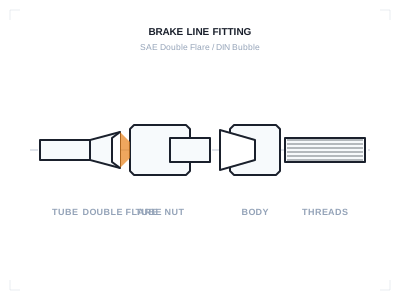
Brake line fittings are a specialized subset of flare fittings used exclusively in automotive hydraulic brake systems. Unlike fuel and oil line fittings — which can use a variety of connection styles — brake line fittings have evolved into two distinct regional standards based on the very high pressure cycling (often above 1,500 psi) and the safety-critical nature of brake hydraulic service.
In North America, the SAE double flare is the dominant brake line standard. The tubing end is double-flared — first flared outward at 45°, then folded back on itself to form a doubled wall at the sealing surface. The doubled wall provides additional thickness and a stress-relieving fold that resists fatigue cracking under repeated brake-pressure cycling. Sizes are typically 3/16" and 1/4" OD for residential automotive work, with 5/16" and 3/8" for heavy-duty and commercial applications.
In European automotive applications, the DIN bubble flare is standard. The tubing end is formed into a rounded bubble shape rather than a doubled cone. The bubble seats against a matching concave seat in the fitting, with the round profile distributing sealing force more evenly than a hard-edged cone. DIN bubble flare fittings use metric thread sizes — typically M10×1.0 and M12×1.0 for brake service.
Brake line fittings also include specialized variants. Inverted flare unions use the SAE double flare profile but with the male flare side reversed — used to join two pre-flared tubing ends without requiring additional flaring during installation. Tubing nuts come in left-hand and right-hand thread variants for use with brake line proportioning valves and master cylinder ports that require specific thread direction for installation clearance.
Material standards are strict for brake service. C36000 brass with copper crush washers is the dominant combination. Plating with cadmium, zinc, or trivalent-chromate is common to prevent corrosion of the threads during the vehicle's service life. PPAP documentation is required for any brake line fitting supplied to OEM automotive assembly.