
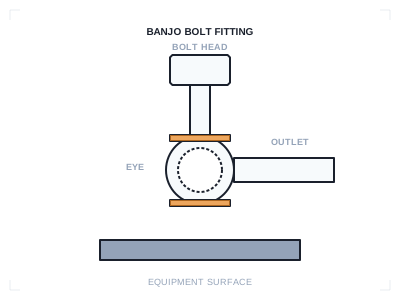
The banjo fitting is a specialized fluid connection style used in automotive applications where a fluid line must terminate at a flat surface — most commonly at brake calipers, brake master cylinders, turbocharger oil feeds and drains, and various OEM fuel and lubrication ports. The name comes from the resemblance of the fitting body to a banjo: a flat ring (the eye) connects to a hollow bolt (the neck) that mounts the assembly to the equipment.
The banjo bolt is a critical part of the assembly. Unlike a normal bolt, the banjo bolt has internal passages drilled through its length and through cross-holes near the head — these passages provide the fluid path from the banjo eye into the equipment beneath. Two crush washers (typically copper, aluminum, or aluminum-bonded) seal between the bolt head and the banjo eye, and between the banjo eye and the equipment surface. Tightening the bolt to a specified torque crushes the washers to create the two seal interfaces.
The banjo eye is the cylindrical ring portion of the fitting, with the bolt passing through the center. The hose or tube connection emerges from the side of the eye, allowing the line to be routed away in any orientation relative to the bolt axis. Common eye configurations include single banjos (one outlet), double banjos (two outlets at 180° for splitting one supply into two), and angled banjos (with the outlet at a specified angle from the bolt axis to suit specific routing geometry).
The banjo style is used in automotive applications because it allows the fluid connection to be made at any rotational orientation around the bolt axis — important for compact engine bays where the hose must be routed past nearby components. It also creates a low-profile connection that doesn't protrude significantly from the equipment surface, suiting locations where space is constrained.
Materials are typically C36000 or C37700 brass for the fitting body, with steel bolts for high-strength applications.